Live translation and captions — run from Australia, Europe and the United States
SpanVoice Try it free

Before you buy

Translation equipment for churches: what it is, and the alternative in the pews.

Search for church translation equipment and you will find transmitters, receivers, earphones and charging cases. They do a real job: carrying a translated voice to the people who need it. This page explains that equipment plainly — what it is, what it costs, what it still needs from you each week — and then the alternative: captions and spoken translation on the phones already in the room, started by one volunteer before the first hymn, with any receivers you already own kept in use.

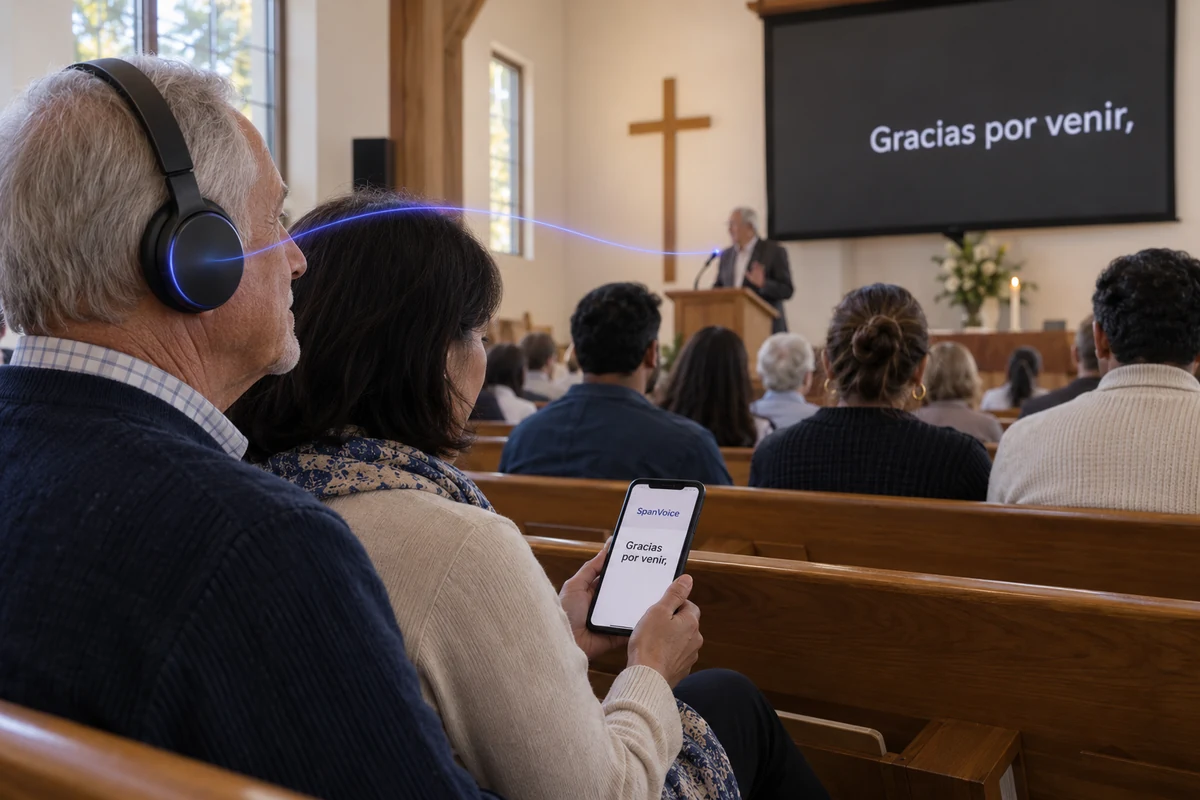
A congregation follows projected captions, with one listener wearing headphones and another reading a phone.

The short answer

A wireless translation system carries audio on one channel per transmitter to a receiver and earphones in each listener’s hand. The audio has to come from somewhere — usually an interpreter, for each language, each service. The alternative here: captions in any of sixty languages and a spoken voice in the languages that have one, on each person’s own phone, from the microphone feed you already have, for A$1.05 per hour, per language. A ninety-minute service in two languages is A$3.15 for captions. If you own receivers, the spoken translation can feed them.

What a church translation system is made of

The parts, and what each one asks of the people who run it.

  • A transmitter

    Sends one audio channel, FM or infrared. A basic system is one transmitter per language; multichannel systems exist at a higher price.

  • Receivers and earphones

    A pocket receiver per listener, tuned to the channel. A brand-name 20-receiver FM pack with earphones lists at about US$4,200; the transmitter is sold separately. That is one configuration, quoted as an example.

  • Power

    Batteries, or a charging case somebody fills before each service.

  • The audio source

    The equipment only carries a voice. For a translated voice that is an interpreter per language — or the spoken translation from this, played into the transmitter.

  • The weekly routine

    Hand-out and collection at the door, earphone hygiene, and a count afterwards.

Side by side

A receiver system, and running this.

  • Languages

    Receiver system

    One per transmitter channel on a basic system.

    SpanVoice

    Captions in any of sixty, each person choosing; a voice in the languages that have one.

  • Who translates

    Receiver system

    An interpreter per language, each service, unless the audio is fed from elsewhere.

    SpanVoice

    Machine, from the existing microphone feed.

  • What listeners hold

    Receiver system

    A receiver and earphones from the box at the door.

    SpanVoice

    Their own phone, from the QR code in the bulletin or on the screen; their own earphones for audio.

  • Reading or listening

    Receiver system

    Listening only.

    SpanVoice

    Captions, spoken translation, or both; the room screen too.

  • Weekly work

    Receiver system

    Charge, hand out, collect, count.

    SpanVoice

    Check the microphone feed, the internet and the audience link; press start.

  • Visitors

    Receiver system

    Need a receiver, and someone to notice.

    SpanVoice

    Scan and read in their own language, unannounced.

  • Cost to begin

    Receiver system

    The equipment, for one language.

    SpanVoice

    A$10 of free credit; then by the hour.

  • Cost to run

    Receiver system

    Interpreters’ time, batteries, replacements.

    SpanVoice

    A$1.05 per hour per language for captions; audio per minute on top; nothing per person.

Keep the receivers you own

If you already have a headphone system, nothing is wasted. The spoken translation plays into your transmitter like any other source, so the members who prefer the receiver they know keep using it, and everyone else uses a phone. The headphone system guide shows the lead and the input.

What a Sunday looks like

The sound desk already has the preacher’s microphone. A laptop or the desk app takes that feed; one volunteer checks the level and the internet, presses start before the service and stop after it. The QR code is on the screen, in the bulletin and on a sign at the door. A family visiting for the first time scans it and reads along in Portuguese; members who prefer to listen put in their own earphones; the room screen shows captions in the room’s language for anyone who hears less well than they used to. Nothing was handed out.

Where the machine falls short

Scripture read from an older translation, proper names and the words your church uses in its own way are where machine translation slips, and an interpreter who knows the congregation does those better. Giving it the names and terms beforehand can help; the accuracy notice says what to expect. A ten-minute rehearsal on a weekday shows you exactly what the congregation would see.

What it costs

One brand-name FM pack for twenty listeners in one language lists at about US$4,200 for receivers and earphones, transmitter extra, and still needs a voice to carry. Here, captions are A$1.05 per hour, per language: one ninety-minute service a week in two languages is A$3.15 per service, which averages A$13.65 a month over a year. Spoken translation is A$0.040 per minute of audio on top. There is no monthly fee and credit never expires, so a church that uses it twice a year pays for two services.

Equipment figure: a US retailer’s published price for one 20-receiver pack, October 2026, in US dollars. Other configurations cost more or less.
Before Sunday

A few good questions.

Not sure what your room needs? Ask us.

Talk to us

What is the best translation system for a church?

The one somebody will actually run every week. Phones with this suit several languages, visitors and a church with one person at the desk, and receivers you already own can carry the spoken translation alongside.

Do we still need an interpreter?

Not for this. The translation is produced by machine from the microphone feed. An interpreter you value can keep one language.

Do people need to install an app?

No. The QR code opens a web page. No download, no account.

What about people without a smartphone?

The screen at the front carries one language in captions, and receivers you already own can carry the spoken translation.

Do listeners need earphones?

To hear the spoken translation on a phone, yes, their own. To read captions, no.

Can it do the sermon and the songs?

The sermon, the notices and the prayers: anything spoken into the microphone. Song lyrics belong on the screen from your projection software, as now.

How accurate is it with Scripture?

Quotations are translated as speech, so they will not match a printed Bible word for word. Names and terms given beforehand can help; the accuracy notice says where it slips.

What does it cost a church?

A$1.05 per hour per language for captions, audio per minute on top, A$10 free to start, no monthly fee. The calculator works out your service.

Can we start this Sunday?

If you have a microphone feed, internet at the desk and ten minutes on a weekday to rehearse, yes.

Try it before Sunday.

A$10 of free credit, no card. Rehearse on a weekday and show the elders what the pews would see.

A$10 of free credit when you sign up, no credit card needed. Credit never expires — use it this week or next year.