We do not know what languages our guests speak. Is that a problem?
No. That is the room this was built for. Guests choose from the full list on the
day, and you are charged only for the languages that were actually used.
Community and cultural events
A wedding, a funeral, a welcome night or a festival brings whatever languages the guests bring, into a hall that was hired for the day, with no technician and no budget for equipment. The speeches run once; every guest picks a language on the phone they came with, and a language costs nothing until somebody chooses it.
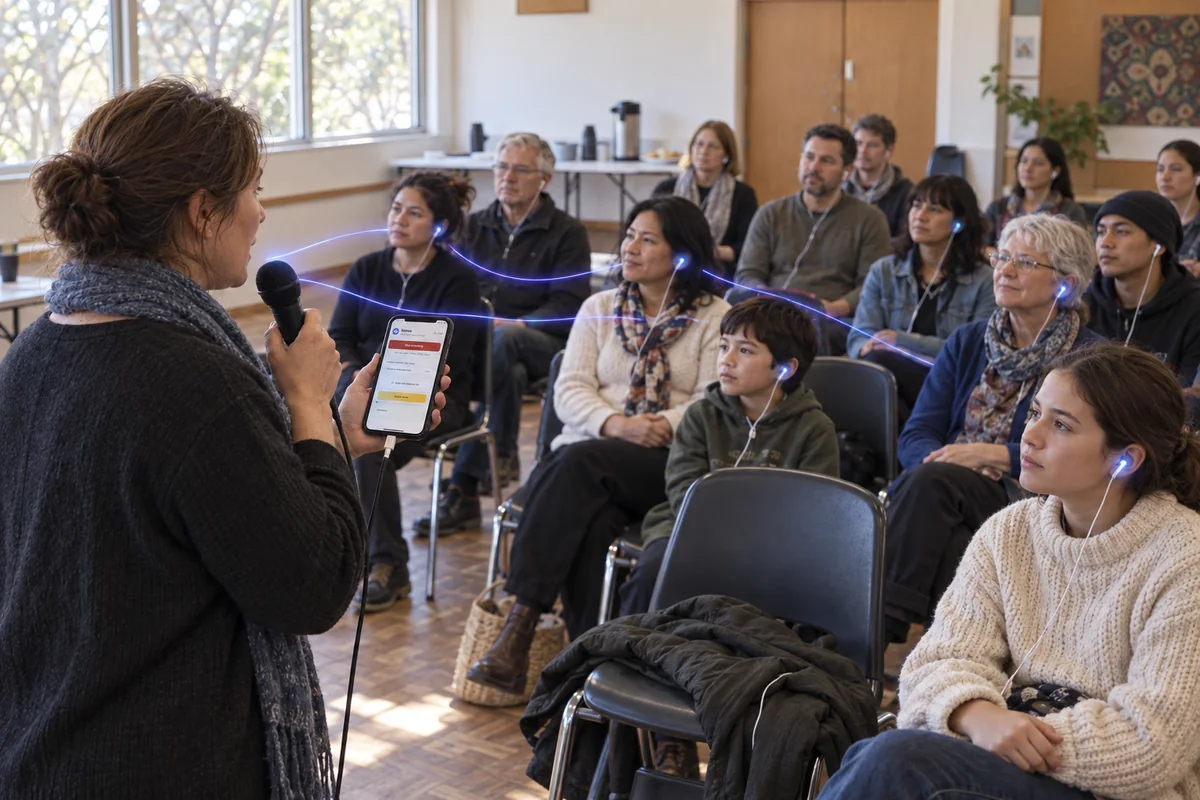
Nobody sends out a language survey with a wedding invitation. The groom’s grandmother arrives, the bride’s cousin brings a partner, and the table at the back is speaking something the organiser has never heard. Every one of them opens the same link and picks from the full list of sixty. The organiser did not have to know, and is not charged for the languages nobody picked.
A funeral is the same list of people with less time to plan. A citizenship or welcome night is a room where, by definition, the languages are not known until the door opens. A community information evening on a new road or a new clinic is the whole suburb, and the suburb speaks what it speaks.
The gatherings a family or a community group puts on, and what the translation does at each.
Both sides of the family read every toast in their own language, from a card at each table, without an interpreter at the top table.
Relatives who flew in follow the eulogies in the language they grieve in, started by a cousin on a phone five minutes beforehand.
A room where the languages are unknown until the door opens. Everyone picks from the full list, and the organiser pays only for the ones chosen.
A new road, a new clinic, a change to bin collection, explained once to the whole suburb in whatever the suburb speaks.
A festival stage with a television on a stand and a QR on the banner, the afternoon programme read in five languages by the crowd.
The annual meeting of a club whose members arrived from six countries, followed by all of them from a laptop at the front.
How it is done
No technician.
No desk to sit at.
A phone or tablet in a browser beside the microphone, or a laptop fed from the hall amplifier. Press start before the speeches.
And on the welcome sign or the order of service: a QR code and the short link written under it, with a cousin nearby for anyone who needs a hand.
The hour it ran, in the languages the guests chose, is what the family pays for. Whatever credit is left stays for the next gathering.
A hall hired for the day has a microphone and not much else. That is enough.
The speeches go through the hall’s microphone; a phone or tablet in a browser, placed near the speaker or fed from the hall amplifier, carries them.
And on the welcome sign, the order of service or the programme. A QR code and the short link under it, and someone at the door who can help an aunt open it.
A cousin starts it on a phone before the speeches and stops it after. There is no desk to sit at and nothing to adjust during the event.
A television on a stand or the hall projector shows the captions in one language for the people who would rather look up than down.
There is no sound desk at a wedding in a community hall and no one whose job it is to run one. The person who starts the captions is a relative with a phone, five minutes before the speeches, and the person who stops them is whoever remembers. Between those two moments nothing needs touching.
If the speeches are in two languages, which at a wedding they often are, set the spoken language to any language beforehand and both sides of the family read every toast. If the master of ceremonies would rather, a second phone with the moderator page switches the language from a seat at the table.
Why SpanVoice
Usually a monthly or annual plan, which a family needs for one afternoon.
The hour the speeches ran, per language. No plan, no subscription.
Often expires with the month or the year.
Credit never expires. The wedding’s leftover pays for the christening.
Often a fixed set chosen when the plan is bought.
Any of the sixty, picked by the guests on the day, charged only for the ones chosen.
Often capped by plan tier.
Forty guests or four hundred, the same price. Nothing per person.
Sometimes a device to buy or hire for the audio source.
A phone in a browser beside the microphone. Nothing to buy or return.
Usually an account set up days ahead, sometimes a sales call.
Sign up the week before, rehearse in your kitchen, run it on the day.
Usually built for conferences or churches.
A browser page that runs from a phone, built by people who run live sound at community halls, and a Windows desk app for the halls that have a desk.
Rarely stated.
Servers in Australia, Europe and the United States.
Compare it yourself: price the afternoon with any service you like.
If you find a similar service for less, tell us and we will look into it.
Worked out the way the person paying for the hall would. Captions are A$1.05 per hour, per language, at today’s rate in AUD. A language is only charged while somebody is listening in it.
An hour of speeches, three languages at the tables. 1 hour, 3 languages — A$3.15.
Ninety minutes, both sides of the family. 1.5 hours, 2 languages — A$3.15.
Two hours, six languages chosen on the night. 2 hours, 6 languages — A$12.60.
An afternoon programme, five languages picked by the crowd. 5 hours, 5 languages — A$26.25.
Before the day
A hall you have not seen yet, or a programme with five speakers? Tell us what you know so far.
Talk to usStart it on a phone in your kitchen, read the captions on another, and you have rehearsed the whole thing.
A$10 of free credit when you sign up, no credit card needed. Credit never expires — use it this week or next year.