Churches
Translation your volunteer can start on a Sunday morning.
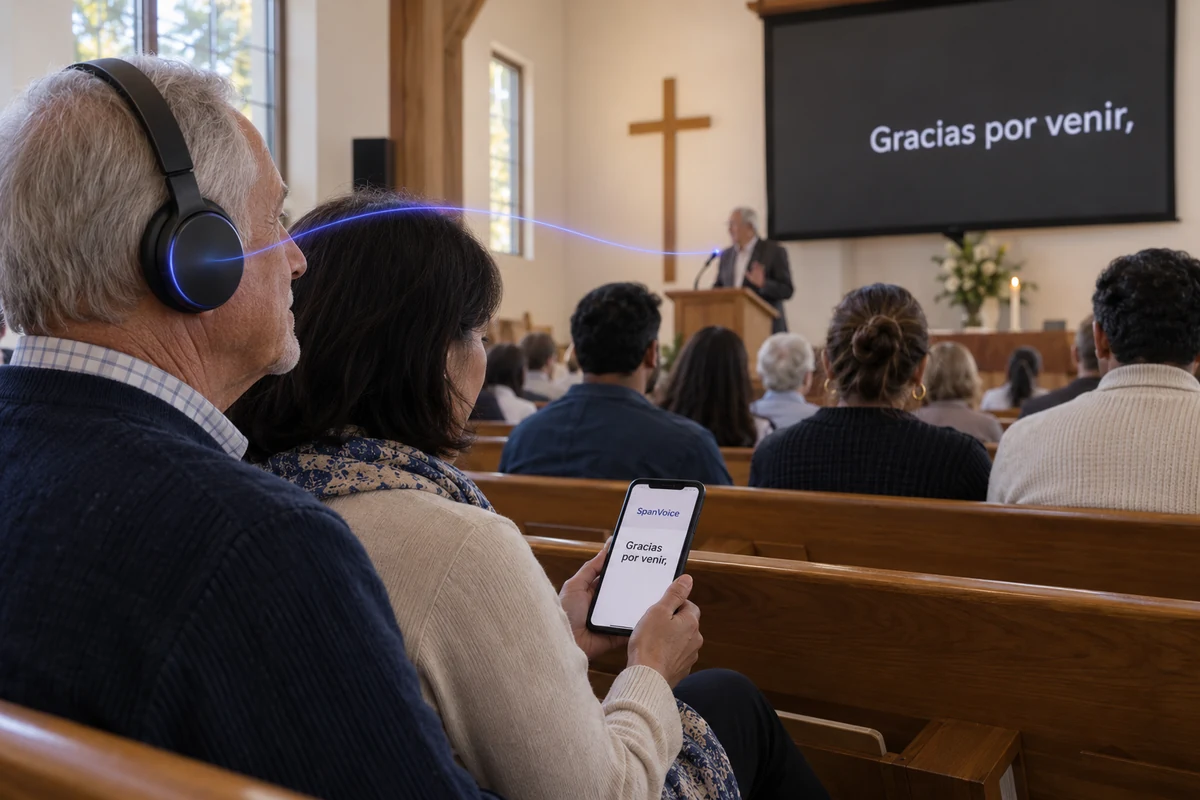
A service is run by whoever turned up early, not by a technician. One person starts the translation before the first song, the congregation reads along in the language each family speaks, and the headphone system you already own can carry the spoken voice. The same routine every week, whoever is on the roster.
Started by a volunteer, before the first song
Church translation has to survive the roster. The person on the desk this week may have done it twice before, and the service starts whether or not they remember every step. So the start is short: open the desk app or the browser page, pick the microphone feed, press start. The listening link on the screen is the same one as last week, and the QR code in the bulletin still works.
From then on the volunteer runs the mixer as usual. There is no second screen to watch and nothing to type during the sermon. If a guest preacher speaks another language, the volunteer taps that language in the app, or sets it to any language beforehand. When the service ends, they press stop, and that is the whole shift.
Where it earns its place in a church
The services and gatherings a congregation runs in a year, and what the translation does at each.
-
Sunday service translation for a bilingual congregation
The sermon in the pastor’s language, read on phones in the language each family speaks, with the room screen carrying the one most of the hall needs.
-
A guest preacher who speaks another language
Switch the spoken language for the sermon and the congregation reads it in theirs; switch back for the notices. Nobody arranges an interpreter.
-
A second-generation congregation
Parents listen in the language of the church; their children read the same sermon in English on a phone, in the same pew, without a youth room.
-
Conference weekends and visiting speakers
Three days, two languages, the same volunteer at the desk. Run it as the service is run, for as many sessions as the weekend has.
-
Weddings, funerals and dedications
The extended family that comes once a year follows the whole service in the language they brought, from a card at the door.
-
Bible studies and midweek meetings
A phone in a browser on the table is enough for a small room. The glossary keeps the names of books and people spelt the way your church spells them.
How it is done, every week
Three things, in order.
The person on the desk sees it once.
Nothing else changes about the service.
-
01 /
Start it before the first song
Open the desk app or the browser page on the computer that runs the screen, pick the microphone feed, press start.
-
02 /
Put the link where the congregation looks
On the screen before the service, in the bulletin, on a card at the door. It is the same link every week.
-
03 /
Stop it after the benediction
Press stop. The hours the service ran, in the languages people chose, are what the church pays for.
What a service needs
A church is not a conference. The room is fixed, the people come back every week, and the budget is a line in the offering.
-
The feed you already send to the speakers
A spare output from the mixer, or the same laptop that runs the lyrics. A pulpit microphone that is already mixed is the cleanest source there is.
- Minimum
- A laptop or tablet in a browser, near the desk
- Better
- The desk app on the Windows computer that runs the screen
-
The link where the congregation can see it
On the screen before the service, in the bulletin, on a card at the door. Families who come every week will have it saved after the first Sunday.
-
Your headphone system, if you have one
A spare phone or tablet opens the listening link in the translated language, and a cable from its headphone socket goes into the transmitter you already use. The people wearing your receivers hear it as before.
-
Names and terms, entered once
The pastor’s name, the name of the church, the words your congregation uses for its own things. Entered once in the venue’s glossary and used every week after.
The weekly routine, as the roster sees it
Before the service: computer on, app open, start. Check the screen shows the link and the first line of captions appears when someone tests the microphone. During the service: nothing. After: stop. The person next on the roster watches once and can do it the following week.
Lyrics belong on the lyrics screen you already run. Stop the captions when the singing starts and start them again when the speaker does; the gap is not charged. Announcements, prayers, the sermon and the notices are all captioned as they are spoken, in the language each person chose.
Why SpanVoice
What churches are usually offered. And what this is.
-
Paying for it
Most translation servicesUsually a monthly or annual plan, charged whether or not a service ran that month.
SpanVoiceThe hours each service runs, per language. A quiet month costs nothing.
-
Hours you did not use
Most translation servicesOften a monthly allowance that resets; annual hour banks that lapse at twelve months.
SpanVoiceCredit never expires. What the church paid for stays until it is used.
-
A second language
Most translation servicesOften one language included and a monthly charge for each one added.
SpanVoiceAny of the sixty, charged only while somebody in the pew is reading it.
-
The size of the congregation
Most translation servicesOften tiers by audience size, or a cap on listeners per plan.
SpanVoiceFifty or five hundred, the same price. Nothing per person.
-
The preacher’s language
Most translation servicesSometimes English in, other languages out.
SpanVoicePreach in any of the sixty. Switch for a guest speaker and switch back.
-
Getting started
Most translation servicesOften an onboarding call, a setup fee, or a device to buy for the sound desk.
SpanVoiceSign up, start a session, read the first line on a phone. Nothing to buy.
-
The app at the desk
Most translation servicesUsually a browser page, sometimes an app built for a different kind of room.
SpanVoiceA Windows desk app and a browser page, built and used weekly by people who run a church sound desk.
-
Where it runs
Most translation servicesRarely stated.
SpanVoiceServers in Australia, Europe and the United States, so the captions keep pace in your part of the world.
-
Price
Most translation servicesCompare it yourself: price your Sunday with any service you like.
SpanVoiceIf you find a similar service for less, tell us and we will look into it.
What a weekly service costs
Worked out the way a treasurer would. Captions are A$1.05 per hour, per language, at today’s rate in AUD. A language is only charged while somebody is listening in it.
-
A Sunday morning service
One language for the families who need it. 1.5 hours, 1 language — A$1.58.
-
A service with two languages running
Two communities in one congregation. 1.5 hours, 2 languages — A$3.15.
-
A month of Sundays, one language
Four services of ninety minutes each. 6 hours, 1 language — A$6.30.
-
A conference weekend
Friday night to Sunday afternoon, two languages. 10 hours, 2 languages — A$21.00.
Before Sunday
Questions from the church office
Run a service with a headphone system or a particular desk? Tell us what you have.
Talk to usCan we keep using the headphones we hand out?
What about the songs?
We only meet once a week. Is there a monthly fee?
Try it this Sunday.
Start it before the first song, put the link on the screen, and let the congregation read along.
A$10 of free credit when you sign up, no credit card needed. Credit never expires — use it this week or next year.