Does IT have to approve an app?
No. There is nothing for staff to install. The listening link opens in the browser
already on their phone, personal or company, and no account is created for them.
Workplaces
An all-hands, an induction or a toolbox talk is only as good as the number of people who followed it. Run the session once, in the language the presenter speaks, and every member of staff reads or listens in the language they think in, on the phone already in their pocket or on the screen in the lunch room.
The monthly all-hands is the same forty people every time. Put the listening link on the first slide and leave it there. After the first meeting, staff have it saved; after the second, nobody asks. The managing director speaks as usual, and the people in the room who would normally nod along read every sentence in their own language.
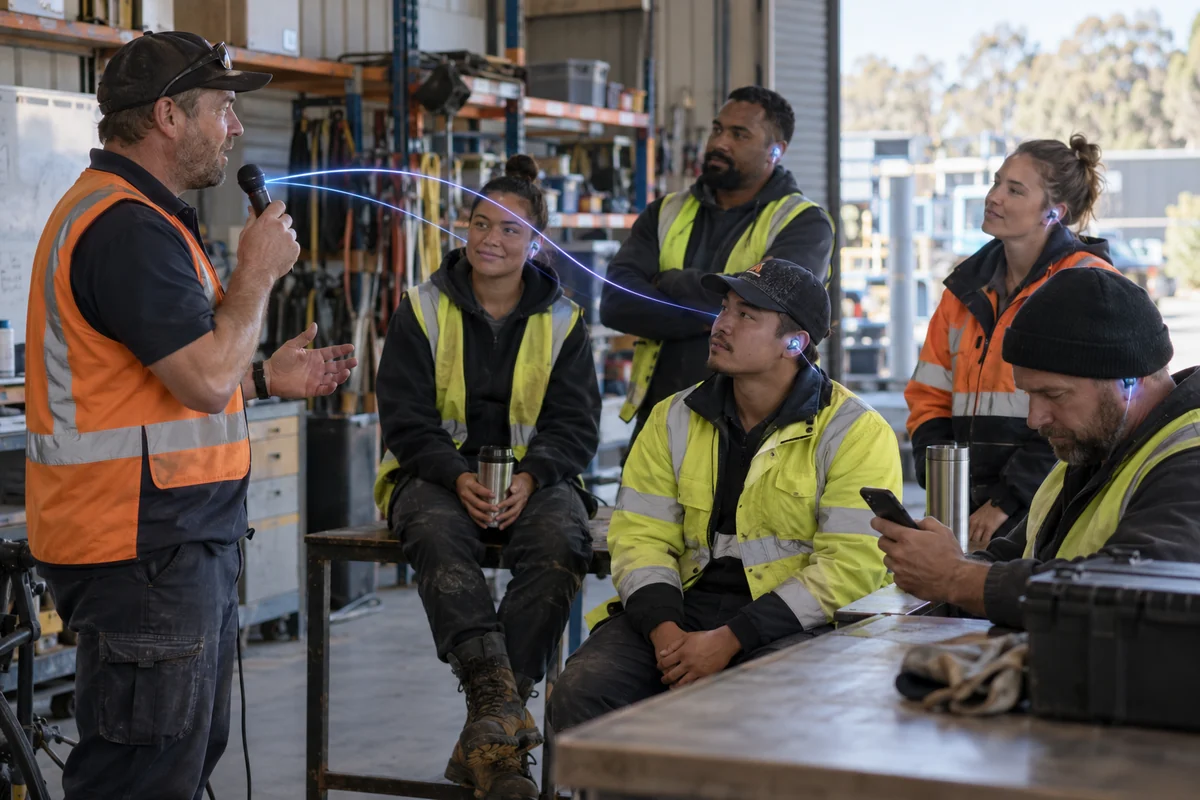
An induction is a new person who cannot afford to miss the safety briefing. A toolbox talk is seven minutes at the start of a shift in a shed with the roller door open. Both run from a phone or a tablet beside whoever is speaking, with the link on a laminated card, and both are over before anyone has to think about equipment.
The sessions a multilingual workforce sits through in a year, and what the translation does at each.
The managing director speaks once; the warehouse, the office and the site crew read the same update in the languages they think in.
A new starter follows the welcome, the roster and the way the site works on their first day, in their own language, alongside the induction your safety people give.
Seven minutes at the start of a shift, from the supervisor’s phone, in the three languages the crew speaks. Charged as seven minutes.
A full-day course read along in two languages, so nobody loses the thread, with the trainer still the one who confirms what was understood.
A change to rosters or conditions explained once, understood by everyone it applies to, with questions from the floor captioned as they are asked.
A visiting delegation follows the plant tour briefing in their language from a QR on the visitor badge.
How it is done
No ticket to IT.
No account for any member of staff.
In the boardroom, the laptop that runs the slides. On the floor, the supervisor’s phone in a browser.
And on the noticeboard and the induction pack. Staff keep it saved after the first session.
The minutes it ran, in the languages staff used, are what the business pays for. A ten-minute talk is ten minutes.
Less than a conference. A presenter, a microphone or a phone, and the link where staff can see it.
In a boardroom or a training room, the laptop that runs the slides. On the floor, the supervisor’s phone in a browser, held or clipped near them.
And on the noticeboard, the induction pack and the card at the sign-in desk. Regular staff keep it saved; new staff find it where they sign in.
Product names, site names, the acronyms your business runs on and the safety terms that must not be mistranslated, entered once in the venue’s glossary and used in every session after.
For a site where people would rather not get the phone out, the room screen shows the captions in the one language the supervisor picks.
There is no account for a staff member to create and no app for IT to approve. The link opens in the browser on whatever phone they carry, company or personal, and the language they pick is remembered on that phone for the rest of the session. A contractor on site for a week uses the same link as a twenty-year employee.
Spoken translation, where you switch it on, plays through their own earphones. On a noisy floor that is often the better choice: a person with earphones in can keep their eyes on the supervisor and their hands free.
Why SpanVoice
Usually a monthly plan with an hours allowance, charged whether or not a meeting ran.
The minutes each session runs, per language. A month with no meetings costs nothing.
Often reset at the end of the month.
Credit never expires. Buy it when the budget allows and use it when the meetings happen.
Often one or two included and a monthly charge for each added.
Any of the sixty, charged only while a member of staff is reading in it.
Often priced by seats or by audience tier.
Forty staff or four thousand, the same price. Nothing per person.
Often an app to approve, a seat licence to manage, a setup fee.
A link in a browser for staff; a Windows desk app or a browser page for the presenter. No seats to manage.
Sometimes a glossary, often not.
Site names, product names and safety terms entered once and spelt your way in every language after.
Usually built for conferences or churches and sold to workplaces as well.
A desk app and a browser page built by people who run live sound and use them weekly.
Rarely stated.
Servers in Australia, Europe and the United States, so a site in any of them is close to one.
Compare it yourself: price a year of all-hands with any service you like.
If you find a similar service for less, tell us and we will look into it.
Worked out the way an HR manager would, against the cost of running the session twice. Captions are A$1.05 per hour, per language, at today’s rate in AUD. A language is only charged while somebody is listening in it.
One hour, two languages. Twelve a year come to twelve times this figure. 1 hour, 2 languages — A$2.10.
A half-day briefing in one language. 3 hours, 1 language — A$3.15.
Five talks of twelve minutes, three languages. 1 hour, 3 languages — A$3.15.
Nine to four with breaks, two languages. 7 hours, 2 languages — A$14.70.
Before the next all-hands
A particular site, a shift pattern, a noisy floor? Tell us how your sessions run.
Talk to usPut the link on the first slide, speak as usual, and watch the room follow.
A$10 of free credit when you sign up, no credit card needed. Credit never expires — use it this week or next year.