Can residents follow without registering?
Yes. There is no registration and no account. The link and QR code on the chamber
screen and at the door open the captions in the browser on their own phone.
Councils and community
A public meeting is for the public, including the resident who walked in off the street without being asked to prepare. Whatever is said into the chamber microphones appears on the screen, on the stream and on the phones in the gallery, in the language each person chose, and the transcript of the meeting is there afterwards.
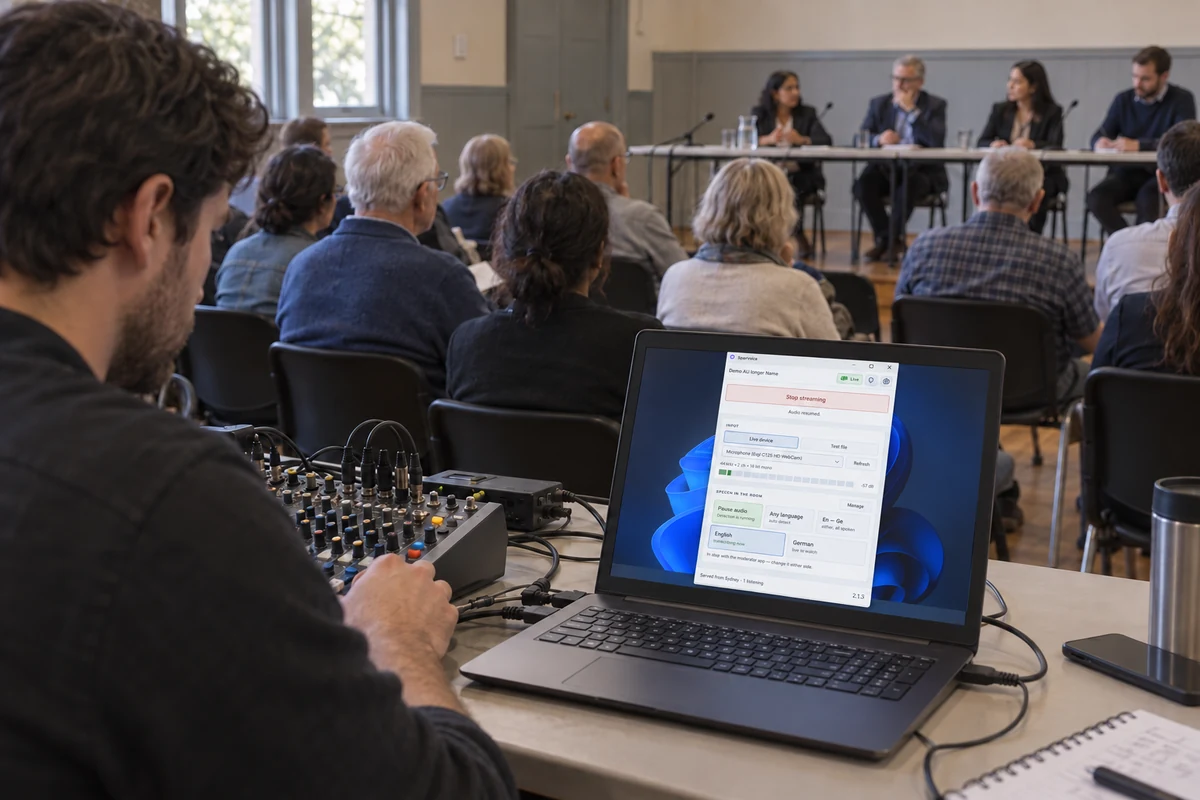
Nobody registers for a council meeting. They see the notice, they come. The listening link and QR code on the chamber screen and on the card at the door are all they need: open it, pick a language, follow the meeting from the item in progress. The person beside them reads a different language, and the officer at the desk did nothing for either of them.
A consultation evening in a community hall runs the same way, from a laptop beside the facilitator. A planning hearing with objectors who read better than they listen runs the same way. The arrangement does not change with the room.
The meetings a council and its community run in a year, and what the translation does at each.
The ordinary and special meetings of council, captioned from the chamber mix for the gallery, the webcast and the record.
A road, a park, a planning scheme explained in a local hall, with residents following in whatever languages the suburb brought.
Objectors who read better than they listen follow the hearing on their phone, and the official record stays the official record.
Families who came for the ceremony follow the mayor’s address in the language they arrived with, from a card on the seat.
A rates change, a new bin system, a works programme explained in the evening, read on phones in the languages the suburb speaks.
A small room, a laptop and a visiting speaker. Captioned the same way as the chamber, at the same rate per hour.
How it is done
The AV desk does the first.
The agenda does the rest.
The feed that already goes to the webcast and the recording, into the desk app on the chamber computer or a laptop in a browser.
Before the meeting opens and during breaks, with a card at the public entrance. Residents open it and pick a language.
The hours the meeting ran, in the languages the gallery used, are what the council pays for. The transcript is in the account afterwards.
A council already has the hard part: fixed microphones, a desk, a screen and a stream.
The same feed that goes to the stream and the recording. Every councillor, officer and speaker at the lectern is already on it.
The link and the QR code on the screen before the meeting opens and during breaks, and on a card at the public entrance.
Councillors, wards, suburbs, the names of local places and the acronyms of your own departments, entered once in the venue’s glossary so the captions spell them as the agenda does.
The caption band goes over the webcast in the language you choose for it. The transcript of the session is kept in your account for the period you set, and can be downloaded.
A resident addresses the chamber in their own language. With the spoken language set to any language, the address is recognised as it was spoken and translated into the language each reader chose, including English for the councillors, so the chair hears it and reads it at once. Otherwise a moderator taps the language from a phone in the room; the desk does not have to stop.
The screen at the front shows one language, chosen by the operator, which for most chambers is English. Everyone who wants another language has it on the phone in their hand.
Why SpanVoice
Usually an annual hour bank bought in advance, or an enterprise quote.
The hours each meeting runs, per language. Nothing bought in advance.
Often valid twelve months; what is left at the end of the financial year lapses.
Credit never expires. It carries across financial years.
Often a base set, with charges per language channel.
Any of the sixty, charged only while a resident is reading in it.
Often plans sized by audience count.
Twelve residents or twelve hundred, the same price. Nothing per person.
Sometimes a transcript, often as an add-on.
A transcript of every session, kept three, six or twelve months as you choose, and downloadable.
Usually a procurement cycle, a sales call and an onboarding period.
Sign up, run a test from the chamber mix, read it in the gallery. Then decide.
Usually a web page the chamber’s AV contractor has not seen before.
A Windows desk app that takes the chamber mix, built and used by people who run live sound, and a browser page for a hall without a desk.
Rarely stated.
Servers in Australia, Europe and the United States.
Compare it yourself: price a year of meetings with any service you like.
If you find a similar service for less, tell us and we will look into it.
Worked out the way a governance officer would, against the price of a single interpreter for one language. Captions are A$1.05 per hour, per language, at today’s rate in AUD. A language is only charged while somebody is listening in it.
A three-hour evening sitting. 3 hours, 2 languages — A$6.30.
A two-hour evening in a local hall. 2 hours, 4 languages — A$8.40.
A full day of submissions. 6 hours, 1 language — A$6.30.
Twelve sittings of three hours. 36 hours, 2 languages — A$75.60.
Before the next sitting
A chamber with its own AV contractor, or a consultation programme across three halls? Tell us.
Talk to usTake the chamber mix, put the link on the screen, and let the gallery follow.
A$10 of free credit when you sign up, no credit card needed. Credit never expires — use it this week or next year.