Tours and guided visits
The group moves. The translation goes with it.
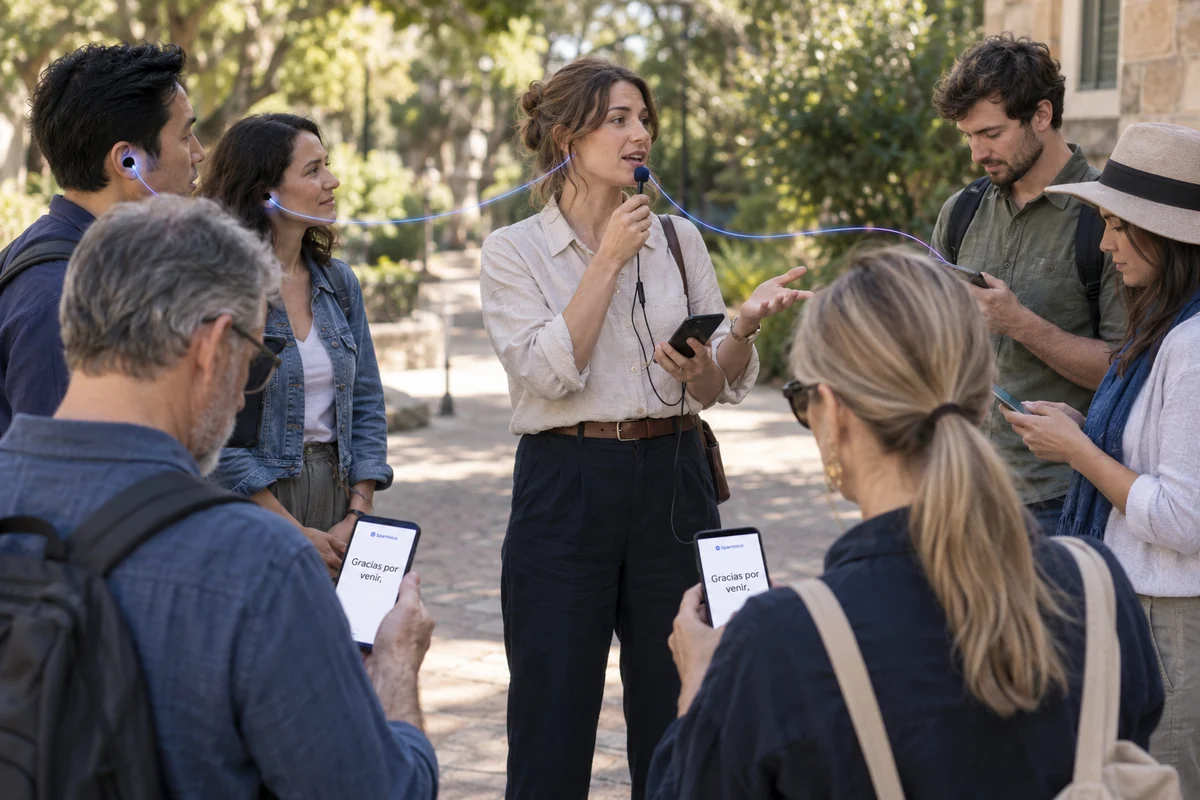
A walking tour has no room, no screen and no desk. The group is spread over thirty metres, half of it cannot hear the guide at any moment, and it re-forms every two hours with a new set of languages. The guide speaks once into a microphone; every visitor reads or listens on the phone already in their pocket.
Thirty metres of group, and the back half cannot hear you
A guide at the front of a moving group reaches the six people nearest them. The twelve behind are reading a plaque, photographing a doorway or waiting for the lights. With the guide’s microphone feeding the captions, the back of the group reads what the front is hearing, in their own language, and nobody has to be shepherded into a huddle at every stop.
A museum or gallery talk is the same group standing still, with the same problem of a soft-spoken guide and a hard floor. A visitor briefing at a heritage site or a plant is the same group with hard hats on.
Where it earns its place on a tour
The kinds of tour and visit an operator runs, and what the translation does at each.
-
Walking tour translation
A city walk with a group spread along the street, the guide’s words reaching the back of the group in the languages it brought.
-
Museum and gallery talks
A soft-spoken guide, a hard floor and a group that cannot all stand at the front. Each visitor reads the talk on a phone, in their language.
-
Heritage sites and historic buildings
Rooms where a group cannot gather in one place and a guide cannot raise their voice. The captions follow the group from room to room.
-
Factory, plant and site visits
A visitor briefing at the gate in four languages, then the tour, with hard hats on and earphones in.
-
Coach tours and transfers
The guide at the front of the coach speaks into a phone; forty passengers read along on theirs, each in their own language.
-
Food, wine and farm tours
A tasting explained once at each stop, read by a mixed group in the languages it chose at the first stop.
How it is done
Three things, before the group sets off.
The guide’s own phone.
No receivers to charge overnight.
-
01 /
Clip a microphone to the guide
A lapel microphone into the guide’s phone, which runs the session in a browser from a pocket or a belt clip.
-
02 /
Hand out the link at the meeting point
On the ticket, the booking email and a sign at the start. Each visitor opens it and picks a language before the first stop.
-
03 /
Start at the first stop, stop at the last
The two hours the tour ran, in the languages the group used, are what the operator pays for. The next group starts the same way.
What a tour needs
Nothing to carry, nothing to collect, no case of receivers to charge overnight.
-
A microphone on the guide
A lapel or headset microphone into the guide’s own phone, which runs the session in a browser from a pocket or a belt clip.
- Minimum
- The guide’s phone and its built-in microphone
- Better
- A clip-on microphone into that phone
-
The link on the ticket
On the booking confirmation, the ticket, a card handed out at the meeting point and a sign at the start. The group has it before the guide says a word.
-
Place names, entered once
Streets, buildings, the names of people in the stories and the words your city uses for its own things, entered once in the venue’s glossary and used on every tour after.
-
A phone signal along the route
The captions travel over the visitors’ own data or the venue wifi. Walk the route once with the phone that will run it, and you know.
A new group every two hours, with different languages each time
The ten o’clock group reads in Korean and French. The midday group reads in Portuguese and Spanish. The guide started and stopped the same session on the same phone, said the same things at the same corners, and did not count a single receiver in or out. Each group picked from the full list, and the operator is charged for the languages each group actually used, for the time the tour actually ran.
Visitors who would rather listen than read put in their own earphones and hear the spoken translation from the same link, eyes on the building rather than the screen.
Why SpanVoice
What tour operators are usually offered. And what this is.
-
Paying for it
Most translation servicesUsually hired receivers by the day, or a monthly plan for the guiding app.
SpanVoiceThe hours each tour runs, per language. A week with no tours costs nothing.
-
Credit you did not use
Most translation servicesOften expires with the month.
SpanVoiceCredit never expires. The quiet season does not waste what the busy one bought.
-
Languages in the group
Most translation servicesOften one channel per language, or a cap on languages per plan.
SpanVoiceAny of the sixty, picked by each visitor, charged only for the ones the group used.
-
Group size
Most translation servicesOften a per-participant charge, or a cap on receivers.
SpanVoiceFour visitors or forty, the same price. Nothing per person.
-
What the guide carries
Most translation servicesOften a transmitter and a case of receivers to charge, count and clean.
SpanVoiceTheir own phone and a clip-on microphone.
-
What the visitor carries
Most translation servicesOften a receiver on a lanyard, handed out and collected.
SpanVoiceTheir own phone, and their own earphones if they would rather listen.
-
The app
Most translation servicesUsually a guiding app built for one kind of tour.
SpanVoiceA browser page that runs from a phone, built by people who run live sound, and a Windows desk app for the visitor centre with a desk.
-
Where it runs
Most translation servicesRarely stated.
SpanVoiceServers in Australia, Europe and the United States.
-
Price
Most translation servicesCompare it yourself: price a season of tours with any service you like.
SpanVoiceIf you find a similar service for less, tell us and we will look into it.
What a day of tours costs
Worked out the way a tour operator would, per tour rather than per receiver. Captions are A$1.05 per hour, per language, at today’s rate in AUD. A language is only charged while somebody is listening in it.
-
One walking tour, two languages
Two hours, two languages in the group. 2 hours, 2 languages — A$4.20.
-
A day of four tours, three languages
Four two-hour tours, three languages across the day. 8 hours, 3 languages — A$25.20.
-
A museum talk, one language
One hour in the gallery. 1 hour, 1 language — A$1.05.
-
A visitor briefing, four languages
Thirty minutes at the gate for a mixed party. 0.5 hours, 4 languages — A$2.10.
Before the next tour
Questions from the tour desk
A route, a site or a museum with its own rules about phones? Tell us how your tours run.
Talk to usWhat do visitors need?
The group changes every tour. Do we set it up again each time?
Is it charged per visitor?
Try it on the next tour.
Clip a microphone to your collar, hand out the link at the meeting point, and let the back of the group read along.
A$10 of free credit when you sign up, no credit card needed. Credit never expires — use it this week or next year.