Live translation and captions — run from Australia, Europe and the United States
SpanVoice Try it free

Compared with

Hiring interpreters, compared with this.

Hiring interpreters means booking people weeks ahead, in pairs, by the day, with a booth and receivers to go with them. This is captions in every language the audience wants, switched on when you like and charged by the hour. Here is what that looks like side by side.

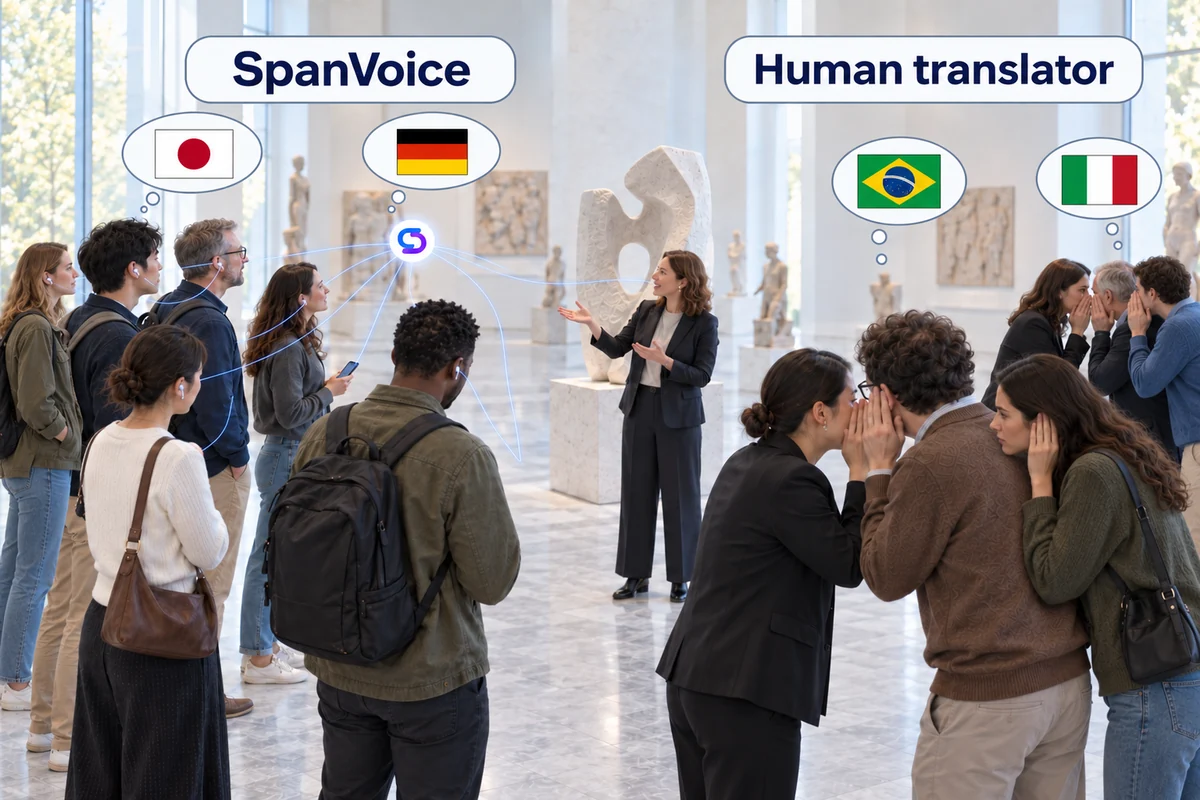
One guided tour, two ways of hearing it: on the left, relaxed visitors with earphones and phones under a SpanVoice label; on the right, two huddles straining to hear whispering interpreters under a Human translator label.

The short answer

When one person speaks to a room that needs more than one language, this does it by the hour instead of by the day: any of sixty languages at once, each person reading or listening on their own phone, with nothing to book and no booth or receivers to arrange. Interpreters are booked by the day, in pairs for simultaneous work, with equipment on top. Here, captions are A$1.05 per hour, per language, with no minimum and nothing per person. The table below goes through it side by side.

Side by side

Hiring interpreters, and running this.

  • Booking

    Hiring interpreters

    Booked weeks ahead for a fixed date, and tied to that date.

    SpanVoice

    Start when you like. Nothing is booked.

  • People per language

    Hiring interpreters

    Two interpreters per language, taking turns every half hour, so the voice in the earpiece changes through the day.

    SpanVoice

    One feed per language, the same from the first minute to the last.

  • Languages

    Hiring interpreters

    One language pair per interpreting team. Each extra language is another team.

    SpanVoice

    Any of the sixty, as many at once as people choose.

  • Keeping up

    Hiring interpreters

    A person tires, pauses for a drink or a cough, hands over mid-sentence, and falls behind when the speaker speeds up.

    SpanVoice

    Keeps pace for as long as you run. Never tires, never steps out, never hands over.

  • Accuracy

    Hiring interpreters

    Rendered from memory in the interpreter’s own words; what was missed is gone.

    SpanVoice

    Every line is written down as it is produced and kept for the period you choose, so it can be read back. It is machine-made; the accuracy notice says where it slips.

  • What you pay for

    Hiring interpreters

    A day rate per interpreter, usually with a half-day minimum, plus travel and a daily allowance when they come from elsewhere.

    SpanVoice

    The hours you run, per language. No minimum, nothing per person.

  • Equipment

    Hiring interpreters

    A booth or a whisper set, receivers for the audience, and often a technician.

    SpanVoice

    The phones people already own, your screen and your stream.

  • The audience

    Hiring interpreters

    Receives one language per channel, through a receiver handed out at the door.

    SpanVoice

    Each person picks their own language on their own phone.

  • Changes on the day

    Hiring interpreters

    A cancellation window, and a late change to the programme is a conversation.

    SpanVoice

    Pause, add a language, stop. Nothing to renegotiate.

What a person cannot do for eight hours

Simultaneous interpreting is hard work, which is why it is done in pairs and in turns. Over a long day the voice changes, the pace drifts, a sentence is lost to a cough or a hand-over, and a speaker who gets excited leaves the interpreter a sentence behind. None of that is a failing of the person; it is what a person is.

This does not tire, does not swap over, and does not shorten a sentence to catch up. The last hour of the day reads like the first, in every language at once, and what was said is written down rather than carried in somebody’s head.

Why this wins the room

One person speaking to a room, and a room that needs to follow in more than one language: a talk, a briefing, a meeting with the public, a conference session, a gathering where the audience arrived speaking four languages and nobody knew which. Each person reads in the language they chose, on their own phone, and the screen at the front carries the one you picked for the room.

It runs the same for a room of fifty and a room of five hundred, it can be switched on for an event that was decided this morning, and it costs by the hour and by the language rather than by the person and by the day.

What it costs, either way

The professional body for conference interpreters puts the daily fee at roughly US$600 to US$1,200 per interpreter, with travel days and a daily allowance on top when they come from elsewhere. Simultaneous work is done in pairs, so one language for one day is two of those fees before the booth, the receivers and the technician. Published guides in the United States quote higher figures again.

Here, captions are A$1.05 per hour, per language. A full day in one language is A$8.40; in four languages, A$33.60. Spoken audio is optional and charged per minute on top. Price your event with anyone you like, then work the same event out here.

Interpreter figures: AIIC, How much will it cost?, and published rate guides, checked October 2026. Rates vary by country, language and season; get a quote for your own event.
  • No lock-in contract

    Nothing recurring, and nothing to cancel. Buy the time you need, when you need it.

  • No minimum

    Run nothing this month and you pay nothing this month. There is no floor to clear.

  • Credit never expires

    Top up once and use it this month or next year. There is no billing period for it to lapse at the end of.

  • Compare us on price

    Price your event wherever you like, then work the same event out here. We are very comfortable being compared.

Before your event

A few good questions.

Deciding between a person and this for a particular room? Ask us.

Talk to us

Can we run this alongside an interpreter we have already booked?

Yes. The captions do not care what else is happening in the room, so a booked interpreter covers one language and this covers the rest, or everyone reads along as a backup.

Is it as accurate as a person?

It is made by machine, so names, numbers and specialist words are where it slips most; the accuracy notice says so plainly, and giving the venue the names and terms beforehand helps. What it adds is a written record that is the same at five in the afternoon as at nine in the morning: it does not tire or hand over mid-sentence, and what was said can be read back. The notice also says where a qualified human interpreter is the right choice.

Does the speaker have to slow down?

No. They speak at their own pace into the microphone they already use. A steady pace and complete sentences give the best result.

How many languages can run at once?

Any of the sixty, any one into any other, and each person chooses their own. A language is charged only while somebody is using it.

What does the audience need?

A phone and the link or QR code. There is nothing to download and no account to make. People who prefer to look up can read the screen at the front.

What if the internet drops?

The desk app keeps trying to reconnect by itself, and within five minutes the same event carries on. Time offline is not billed. The internet guide covers a backup connection.

Is there a record afterwards?

Yes. Each event leaves a written transcript that can be read and downloaded, kept for three, six or twelve months as you choose.

We only need this a few times a year. Is it still worth it?

Yes. There is no monthly fee and credit never expires, so an account used twice a year costs exactly the hours of those two events and nothing in between.

What about questions from the floor?

Whatever comes through the microphone is captioned. A question asked into the room microphone is translated like anything else; one shouted from the back is not.

Try it on your next event.

Your free credit covers a few ordinary events. See what the room would see before you book anyone.

A$10 of free credit when you sign up, no credit card needed. Credit never expires — use it this week or next year.