Schools and education
Sessions parents and students can follow.
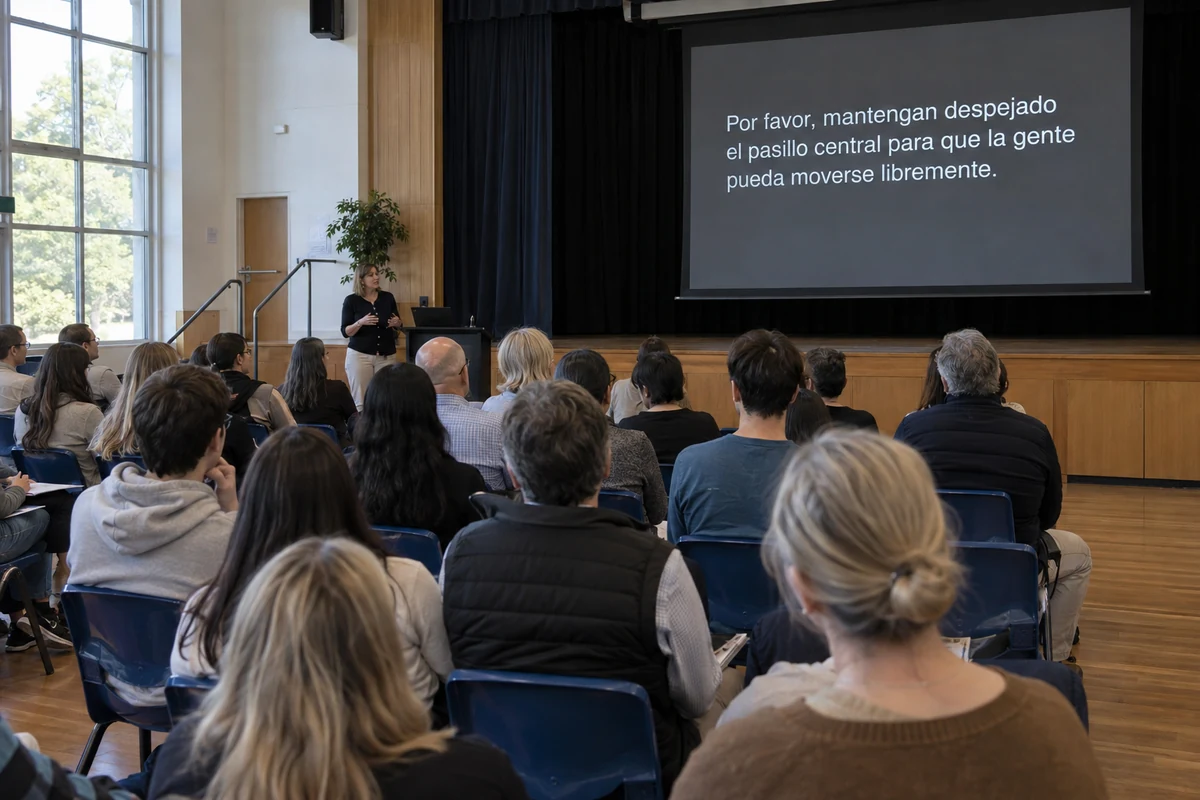
A lecture, a seminar or a parent information evening has a room full of people with limited attention to spare. The presenter speaks as usual; students and families read along in the language they think in, on the projector for the whole room or on a phone for the people who need another language.
The presenter changes nothing
A lecturer with ninety minutes of material does not have time to run a second system. The session is started from the lectern laptop or by the person at the hall desk, the link sits on the first slide, and the lecturer speaks at their normal pace. Students who read faster than they listen in a second language keep up with the lecture instead of reconstructing it afterwards.
A seminar with discussion works the same way, as long as the discussion goes through a microphone. A workshop that moves between the whiteboard and the tables runs from a phone in the presenter’s pocket.
Where it earns its place in education
The sessions a school, college or university runs in a year, and what the translation does at each.
-
Lecture translation for international students
Ninety minutes of a subject read along in the student’s own language, at the lecturer’s normal pace, with a transcript the lecturer can share after.
-
Parent information evenings
The principal speaks once; two hundred families follow in a dozen languages from a QR in the letter home. Nothing printed in twelve languages.
-
Orientation and enrolment sessions
New students and their families follow the welcome day, the campus tour briefing and the enrolment talk in the language they arrived with.
-
Seminars, workshops and guest lectures
A visiting speaker in another language, read by the room in theirs. Set the spoken language for the session and switch back after.
-
School assemblies and award nights
Grandparents at the back of the hall follow the speeches on the projector or on a phone, in their language.
-
Staff meetings and professional development
A multilingual teaching staff follows the training day on their own phones, and the presenter does nothing differently.
How it is done
Three things, and the lecture starts on time.
The hall desk or the lectern laptop.
Either is enough.
-
01 /
Start it from the lectern
The lectern laptop in a browser, or the desk app on the hall computer fed from the hall mixer. Pick the microphone, press start.
-
02 /
Put the link on the first slide
And in the course page or the letter home. The projector shows the captions in the language the presenter picks for the room.
-
03 /
Stop it with the last slide
The hours the session ran, in the languages the room used, are what the school pays for. The transcript is in the account afterwards.
What a lecture hall or school hall needs
Most already have it: a lectern microphone, a projector and a laptop that runs the slides.
-
The lectern microphone
The feed that already goes to the hall speakers. A lapel microphone through the hall desk is the cleanest source; a laptop on the lectern is enough.
- Minimum
- The lectern laptop in a browser
- Better
- The desk app on the hall computer, fed from the hall mixer
-
The projector, for the whole room
The captions go on the screen beside or below the slides in the one language the presenter picks, for the families who would rather not get a phone out.
-
The subject’s own vocabulary
Course names, the names of staff and buildings, and the technical terms of the subject, entered once in the venue’s glossary so they come out the same every lecture.
-
The link on the first slide
And in the course page, the enrolment pack and the letter home. A family who came to one evening has it for the next.
A parent information evening
Two hundred parents, a principal with forty slides, and a dozen languages in the room that nobody counted beforehand. The link and the QR code go in the letter home and on the screen as people arrive. Each family picks a language on arrival; the principal speaks once. Questions at the end go through the roving microphone and are captioned like everything else.
The families who have been coming for years and the family that enrolled last week follow the same evening, in the languages they chose. Nothing was printed in twelve languages, and nothing was left over.
Why SpanVoice
What schools are usually offered. And what this is.
-
Paying for it
Most translation servicesUsually an annual plan, sometimes with an education discount, charged across the holidays as well as the term.
SpanVoiceThe hours each session runs, per language. The holidays cost nothing.
-
Hours you did not use
Most translation servicesOften a monthly allowance that resets, or an annual bank that lapses.
SpanVoiceCredit never expires. What is left at the end of the year is there next year.
-
Languages in the hall
Most translation servicesOften a base set, with a charge for each language added.
SpanVoiceAny of the sixty, charged only while a student or parent is reading in it.
-
The size of the room
Most translation servicesOften plans sized by audience count or seats.
SpanVoiceA tutorial of twelve or a hall of twelve hundred, the same price.
-
The subject’s words
Most translation servicesSometimes a glossary, often not.
SpanVoiceCourse names, staff names and technical terms entered once and spelt the same in every language after.
-
Getting started
Most translation servicesUsually a quote, an onboarding call and an IT approval.
SpanVoiceSign up, run a test from the lectern, read it at the back of the hall. Then decide.
-
The app at the lectern
Most translation servicesUsually a web page, sometimes an app for a different kind of room.
SpanVoiceA Windows desk app for the hall computer and a browser page for the lectern laptop, built by people who run live sound and use them weekly.
-
Where it runs
Most translation servicesRarely stated.
SpanVoiceServers in Australia, Europe and the United States.
-
Price
Most translation servicesCompare it yourself: price a term of sessions with any service you like.
SpanVoiceIf you find a similar service for less, tell us and we will look into it.
What a term of sessions costs
Worked out the way a bursar would, against the cost of printing and interpreting. Captions are A$1.05 per hour, per language, at today’s rate in AUD. A language is only charged while somebody is listening in it.
-
A parent information evening, four languages
Ninety minutes with a mixed set of families. 1.5 hours, 4 languages — A$6.30.
-
A weekly lecture, one language, for a term
Twelve lectures of ninety minutes. 18 hours, 1 language — A$18.90.
-
An orientation day, three languages
A full day for new students and families. 6 hours, 3 languages — A$18.90.
-
An enrolment session, two languages
One hour on a Saturday morning. 1 hour, 2 languages — A$2.10.
Before the next evening
Questions from the school office
A hall with its own AV, a campus with more than one theatre, or a letter home to write? Tell us.
Talk to usCan families follow without a phone?
Our subject has its own vocabulary. Will the terms be right?
We only run an evening like this twice a year. Is there a fee between them?
Try it at the next lecture.
Put the link on the first slide, speak at your usual pace, and let the hall read along.
A$10 of free credit when you sign up, no credit card needed. Credit never expires — use it this week or next year.