What does CART stand for?
Communication Access Realtime Translation: a trained captioner writing speech as text, live, as an access service. “Translation” here means speech to text, not between languages.
Before you buy
CART — Communication Access Realtime Translation — is captioning by a trained captioner, live, as an access service for people who are deaf or hard of hearing. This is captioning by machine: automated, available on no notice, much cheaper, and able to translate as well as caption. They are not the same service. Here is what each provides, so you can choose for the people in your room.
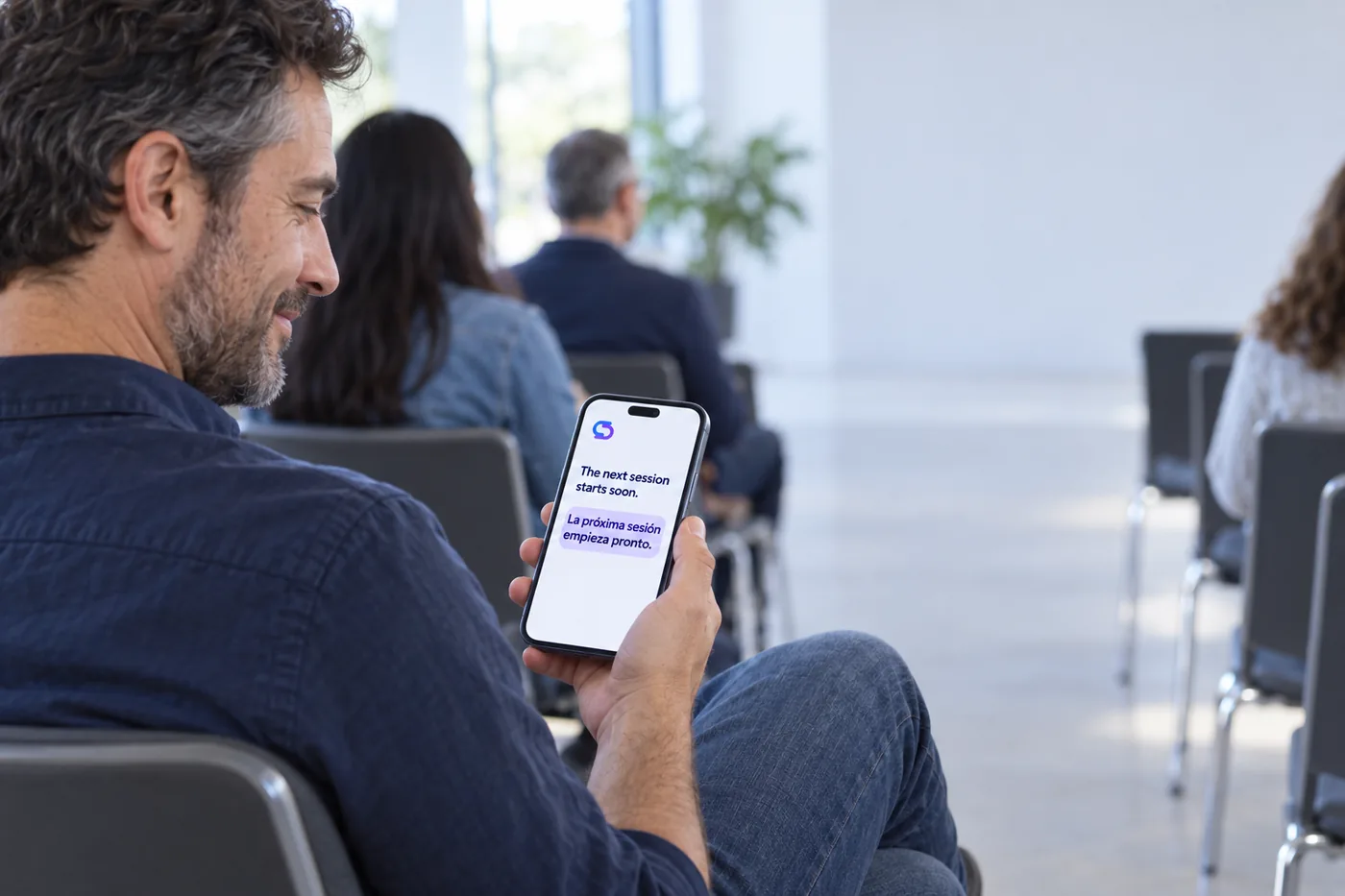
If someone at your event has asked for CART, or your access policy provides it, book a captioner: that is a professional access service and this is not a replacement for it. For the many events that would like captions on the screen and on phones and have no captioning budget — a service, a lecture, a staff meeting, a public forum — this puts them there for A$1.05 per hour, per language, and adds translation into sixty languages, which is a separate service from same-language captioning. The two can be used alongside each other.
Side by side
A trained captioner, on site or remote.
Machine, live.
Speech, with speaker identification and meaningful sounds described, to a professional standard.
Speech as spoken. No speaker labels; sounds are not described. The accuracy notice says where it slips.
Primarily same-language captions.
Same-language captions, and translation into any of sixty.
Days to weeks ahead; minimums and short-notice premiums are usual.
Start now.
Published US examples: US$125–300 an hour, plus minimums, travel and display equipment.
A$1.05 per hour, per language; no minimum.
A display driven by the captioner’s software, or a stream.
Your projector, every phone, your stream, from one session.
A transcript, often tidied afterwards for a fee.
A transcript in every language, kept for the period you choose.
People who need an access service.
Rooms that want captions and translation and would otherwise have neither.
A CART captioner is trained to write speech as text, live, with the speaker identified and the sounds that matter described, so that a deaf or hard-of-hearing person can take part in a meeting, a class or a hearing on the same footing as everyone else. If someone has asked for it, that request is the answer. Run this alongside if you want the captions also on every phone and in every language.
Most rooms that would benefit from captions never get them, because the quote came back in the hundreds per hour with a minimum and a week’s notice. This is for those rooms: the Sunday service, the weekly lecture, the all-hands, the council meeting, the breakout nobody budgeted a captioner for. Captions on the screen and on every phone, started by the person at the desk — and the same captions translated, at the same time, into whatever language each person chose.
A professional captioner is trained and certified to a standard. Machine captions on a clear microphone and a steady speaker read well on ordinary speech and fall away on proper names, figures and jargon; names and terms given beforehand can help. The accuracy notice on this site is written so you can judge for your own room, and a ten-minute rehearsal shows you.
Published US examples put remote CART at US$125–250 an hour and on-site at US$150–300, with minimums, premiums for short notice and evenings, and display equipment on top; one non-profit provider’s price list shows US$136 an hour remote and US$175.50 on site after a three-hour minimum. Those are examples, not market averages. Here, captions are A$1.05 per hour, per language: a full day is A$8.40; a full day in four languages is A$33.60. No minimum, nothing per attendee. The cost-per-hour page has the whole comparison.
CART figures: a published US rate guide and one provider’s price list, checked October 2026, in US dollars.
Before your event
Choosing captioning for a particular audience? Ask us.
Talk to usA$10 of free credit, no card. Run a rehearsal and judge for yourself.
A$10 of free credit when you sign up, no credit card needed. Credit never expires — use it this week or next year.